
 Metal roofing
 Architectural shingles
 Tile roofing
 GAF
GAF Owens Corning
 Flat & low-slope
Free roof inspection with deck photos before we talk money - GAF and Owens Corning certified installation
IKO Flashing Replacement: The Orange County Owner’s Guide
IKO flashing replacement in Orange County typically runs $350 to $900 installed for a standard penetration or wall flashing repair, depending on access and how much surrounding roofing material has to come apart. We stock IKO-compatible flashing and related parts on our trucks, so most flashing work is done in a single visit, not two or three. You usually find out flashing has failed the hard way: a water stain on the ceiling, a damp spot in the attic after a Santa Ana-driven rain, or granules and rust flakes collecting in a gutter below a wall junction.
Flashing is the metal or membrane material that bridges the seams where your IKO roof meets something else: a chimney, a vent pipe, a skylight, a wall, or a valley. When it fails, water gets behind the shingles and into the decking, often months before you see anything inside the house. In Orange County, we see two failure patterns over and over: sun-baked exposed flashing on south-facing slopes in Anaheim Hills and Yorba Linda, and corroded step flashing along stucco walls closer to the coast in Huntington Beach and Newport Beach, where salt air accelerates the breakdown. It is not an IKO-specific defect. It is what weather does to metal over time.
Which IKO Models This Applies To
IKO flashing is not a single universal part. The manufacturer specs different flashing approaches for different roof systems, and matching the replacement to the existing installation matters.
For IKO asphalt shingle systems (Cambridge, Dynasty, Nordic, Marathon lines), the critical compatibility points are the shingle profile and exposure. IKO’s heavier laminate shingles in the Nordic and Dynasty lines sit thicker than the Cambridge line, which changes how step flashing and counter-flashing have to be nested. If the wrong gauge flashing goes in, the shingles will not lay flat, and you will see a hump at every wall junction. It looks wrong on day one and leaks within two years.
For IKO’s low-slope systems and their Armourbase and Roof-Pro underlayments, flashing replacement usually involves peel-and-stick or torch-grade flashing membranes rather than sheet metal. Matching the membrane to what was originally installed prevents adhesion failures between old and new material.
The easiest way to identify what you have without climbing a ladder: check the paperwork from the original install. The shingle line and color are often listed on the permit, the proposal, or the invoice. We can also identify the shingle from the job site during a free estimate, but having the original spec saves a step.
On OEM versus aftermarket: IKO does not manufacture its own flashing metal. Flashing is sourced from metal fabricators and is specced to match the roof system. What matters is gauge, width, finish (galvanized, aluminum, or painted), and correct bending for the junction. We use flashing that matches or exceeds the original spec, and we bend most step flashing on site so it fits the actual wall, not a generic profile.
Styles & brands we work with
Signs Your IKO Flashing Replacement Is Failing
- Water staining on ceilings or walls below a chimney, skylight, or wall junction. This is the classic first sign. The leak path may be ten feet from where the water shows up. Flashing failures let water run along rafters before it drops.
- Rust or corrosion visible on exposed flashing. In Orange County, galvanized flashing on south-facing slopes can start showing rust in as little as 8 to 12 years. Coastal salt air cuts that further. Rust means the protective coating is gone and the metal is thinning.
- Lifted, cracked, or missing counter-flashing at walls and chimneys. Wind, movement, and drying sealant cause metal to pull away from stucco and masonry. Once the gap opens, water gets behind the flashing every time it rains.
- Granules or small shingle pieces in gutters below a valley or wall junction. Water getting under shingles at a flashing point will slowly erode the shingle underside. Granule loss in an isolated spot points to a flashing problem, not just shingle age.
- Damp or soft roof decking visible from the attic near penetrations. If you can see the underside of the sheathing and it is darkened or soft around a vent pipe or chimney, the flashing there has been leaking for a while.
See the difference
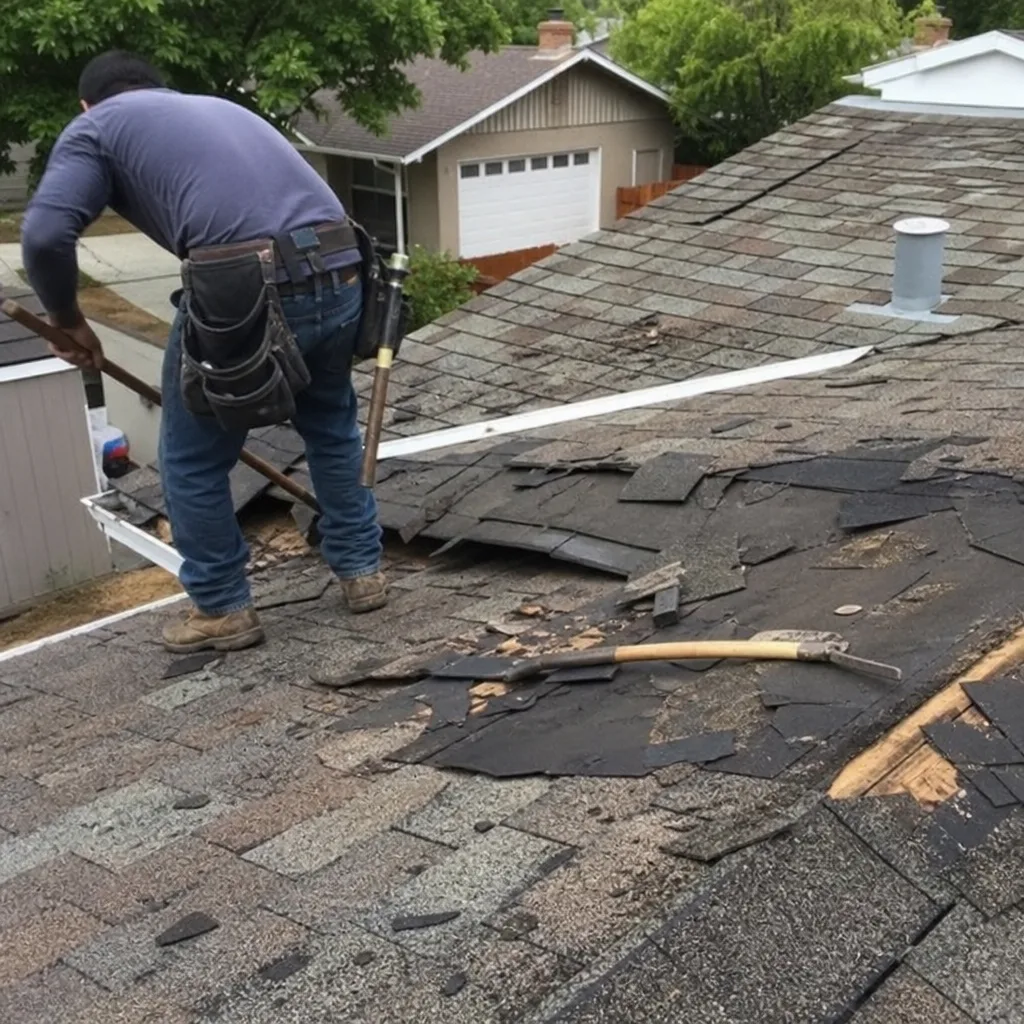 Before
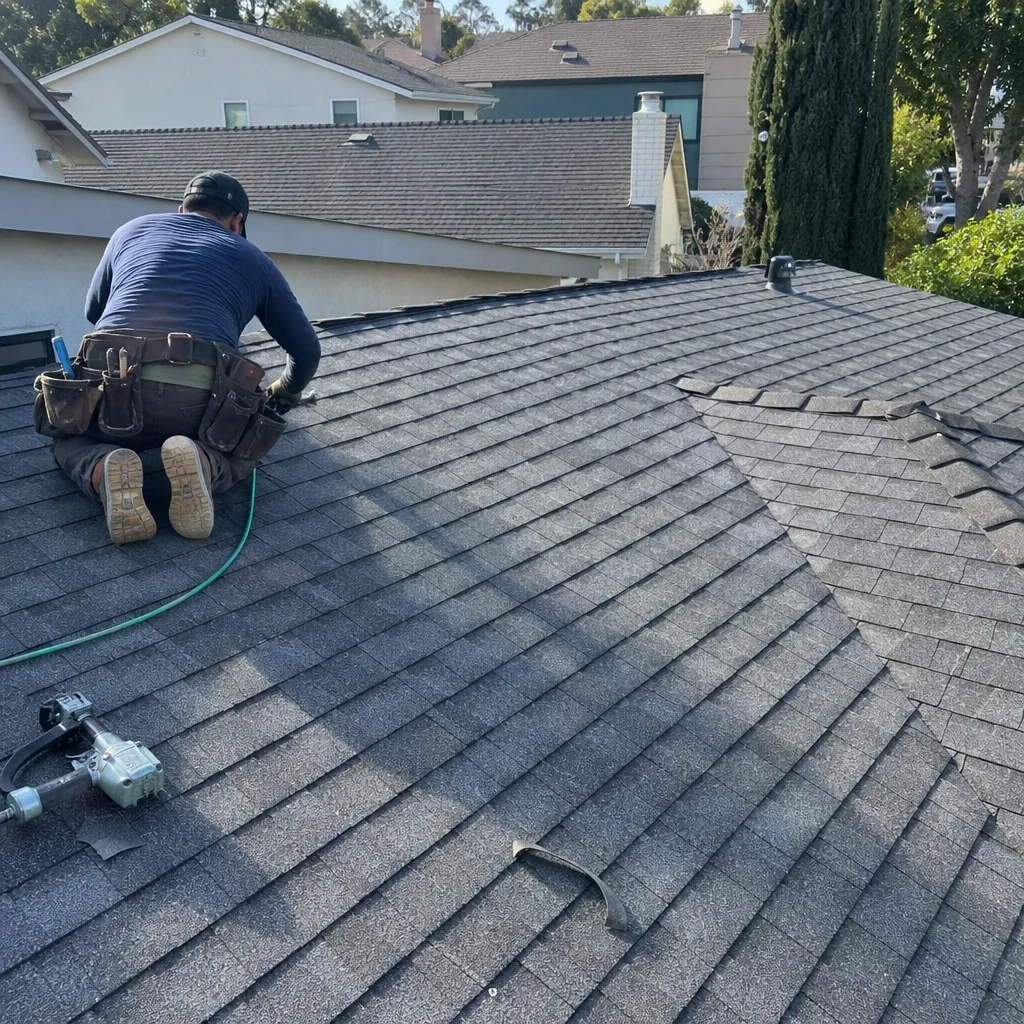 After
After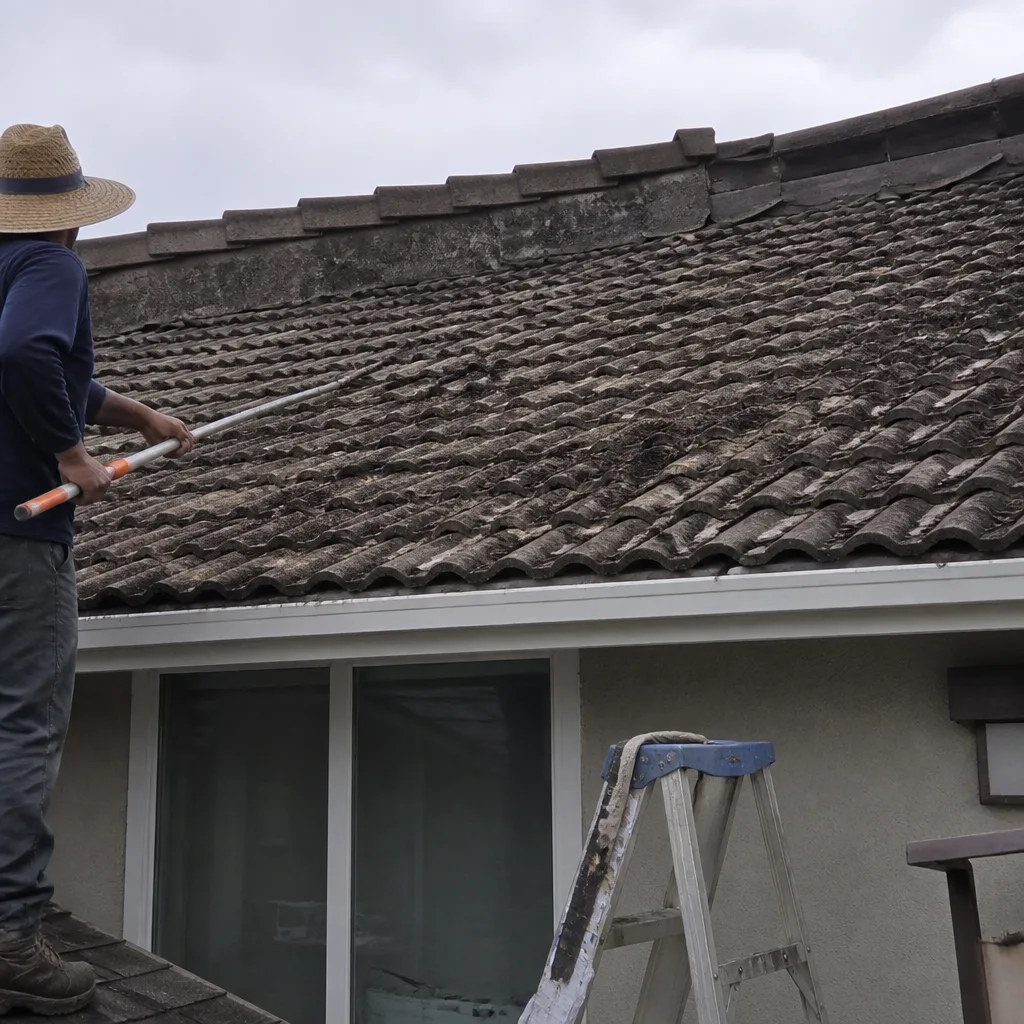 Before
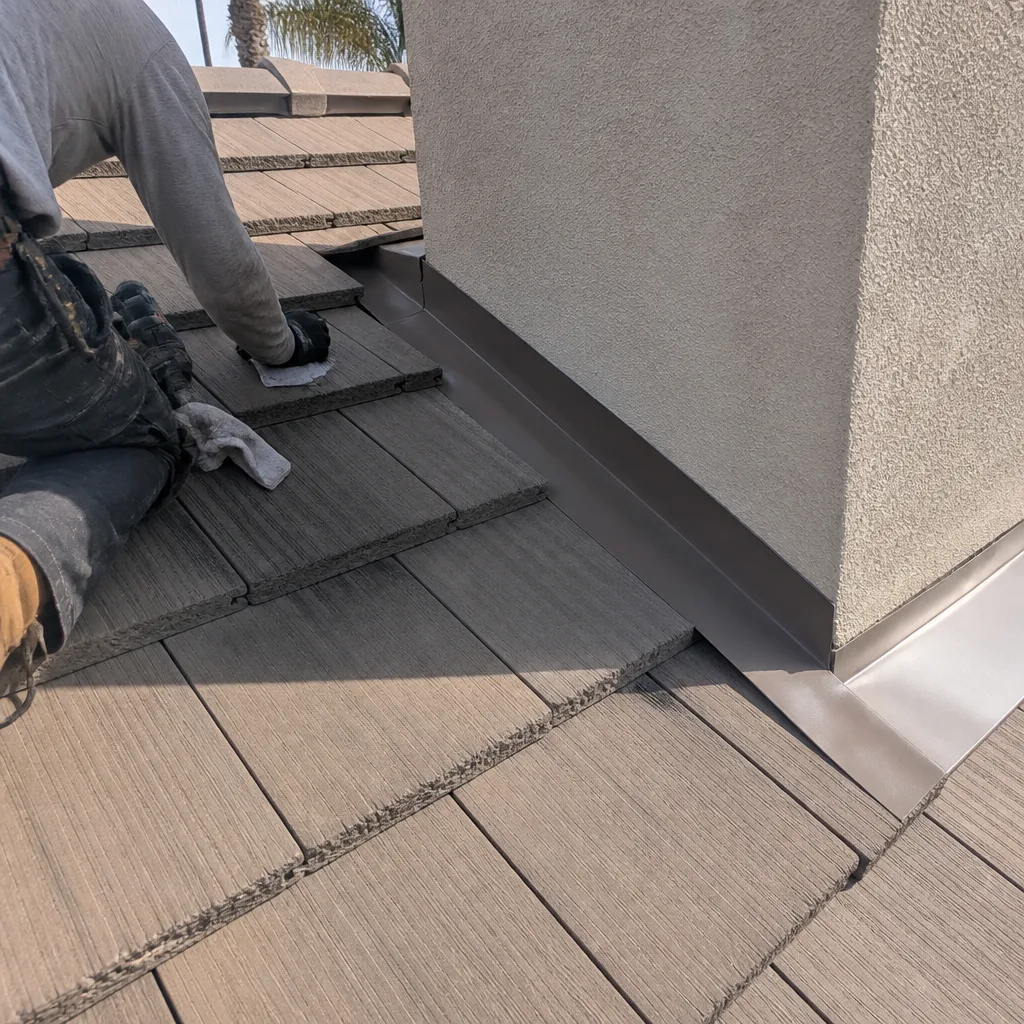 After
After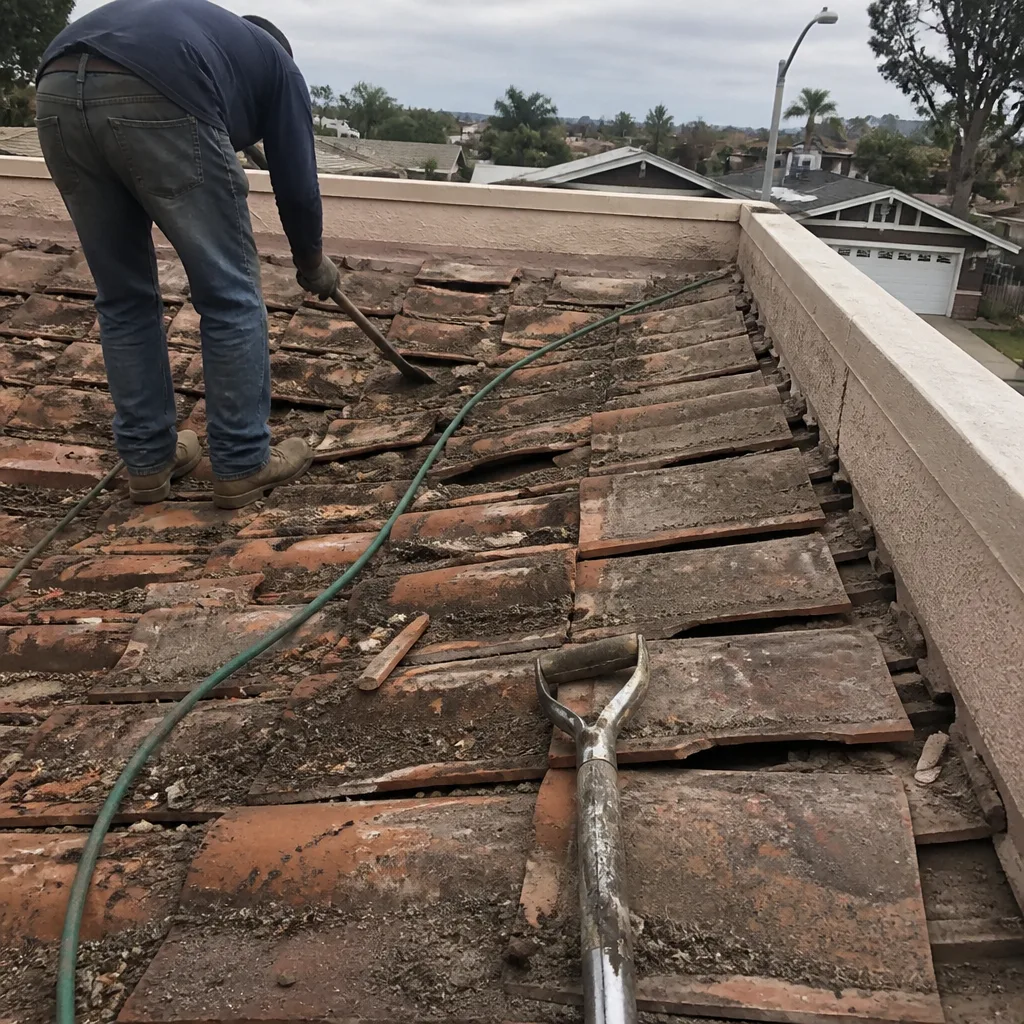 Before
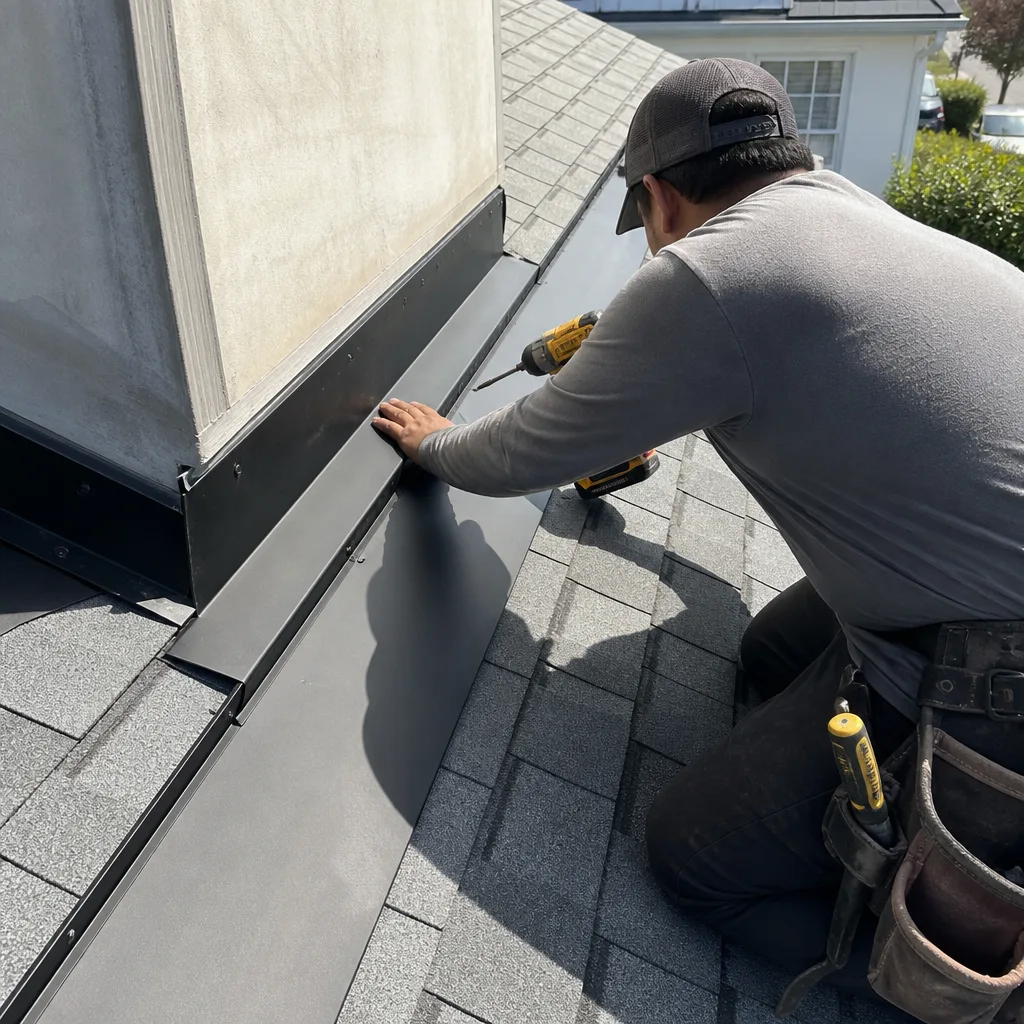 After
AfterReplacement Cost & What’s Included
Here is what IKO flashing replacement costs in Orange County, installed, as a line-item reality rather than a ballpark.
- Pipe boot / vent flashing replacement: $180 to $350. One pipe, standard access, shingles lifted and re-seated around the new boot.
- Step flashing replacement along a wall (up to 10 linear feet): $400 to $800. Shingles pulled back, old flashing removed, new step flashing and counter-flashing installed, shingles re-fastened.
- Chimney flashing replacement: $550 to $1,100. Includes removal of old flashing, a cricket if needed, new step and counter-flashing, and sealant at the masonry with a proper urethane or silicone.
- Valley flashing replacement: $350 to $750 depending on valley length and whether shingles on both sides need to be lifted and re-nailed.
What drives the range: roof pitch and access. A steep two-story roof in Mission Viejo with a chimney that requires full scaffolding costs more than a single-story ranch in Fountain Valley where the crew can work from a ladder in the driveway. The price goes on paper before any work starts. It does not move at the door. Every flashing replacement under the Brennan Roofing Co Orange County name carries the 365-Day Done Right Promise: in writing, for one full year, and we come back for free if it fails.
DIY or Call Us?
Flashing is not a spring under tension or a live wire, so it does not carry the same immediate physical danger as some home repairs. But the stakes are high because the failure is silent. A flashing replacement that is off by a quarter inch in how the metal overlaps will not leak the day you finish. It will leak 14 months later, after the first heavy winter rain, and by then the decking is involved.
What a homeowner can safely do: look at the exposed flashing from the ground with binoculars, check the attic after a rain, clear leaves and debris from valleys so water is not dammed at flashing points. That is genuinely useful and costs nothing.
What we would not do ourselves if we were not roofers: pull shingles, remove and re-bend step flashing, or seal a chimney flashing from a ladder without proper fall protection. Most of the flashing failures Travis Oakley has fixed in Orange County came from two places: original installs where the flashing was not tucked correctly, or well-meaning DIY repairs that used roofing cement as a substitute for metal. Roofing cement dries, cracks, and fails. Metal does the job when it is bent right and layered so water always runs down and out. If you are not certain the last layer sheds water correctly, you are not saving money. Call (559) 258-5703 and we will price it before any work starts.
FAQs
Galvanized flashing in Orange County typically lasts 15 to 25 years depending on sun exposure and proximity to salt air. Coastal homes in Newport Beach and Corona del Mar often need flashing replacement 5 to 8 years sooner than inland homes in Tustin or Orange, because salt accelerates corrosion. Call (559) 258-5703 for an inspection if your flashing is showing rust or lifting.
In some cases, yes: a small gap at counter-flashing can be re-sealed with the right urethane, and a pipe boot with a torn rubber collar can sometimes be sleeved. But patching corroded or improperly layered metal is a temporary fix. In Travis Oakley’s experience, a homeowner usually gets one extra season out of a patch, then the same leak returns. We will tell you honestly which bucket your flashing falls into, and the honest answer is often replacement because it costs less than repeated patching over three years.
A standard pipe boot or short step flashing replacement is done in two to four hours. A full chimney flashing replacement with a cricket can take a full day. Most flashing work from Brennan Roofing Co Orange County is single-visit because we stock the flashing we need on the truck. Call (559) 258-5703 and we will give you a written time estimate with the price.
We stock common flashing profiles, pipe boots in standard sizes, step flashing in galvanized and aluminum, and counter-flashing on our trucks. If your roof needs a non-standard gauge or a custom-bent profile, we fabricate it on site. We also install and match flashing for GAF, Owens Corning, and CertainTeed systems, so if your home has mixed materials or prior patches from different brands, we can sort it out in one visit.
Written by Travis Oakley, Owner, Brennan Roofing Co Orange County at Brennan Roofing Co Orange County, serving Orange County and nearby areas.